
How Generative AI is Transforming Hotel Design
The tools architects use to design hotels have evolved dramatically over the last few decades. What once started with T-squares, compasses, and drafting boards has now entered an era driven by artificial intelligence. From AutoCAD’s digital drafting in the 1980s to today’s powerful Building Information Modeling (BIM) platforms, each leap in technology has reshaped how we imagine, plan, and deliver hospitality spaces. Now, a new wave of intelligence has entered. Generative AI (GenAI) is redefining what’s possible in hotel design.
From Generative Design to Generative AI
Generative Design (GenD) tools like Revit, Grasshopper, and TestFit have long focused on logic and function, helping architects optimize floor plans, materials, and systems through data-driven modeling. These tools strengthen the “left-brain” of functional and efficient building design: analytical thinking, problem-solving, and efficiency.
GenAI, on the other hand, brings the “right-brain” back into the process. It uses deep learning and neural networks to generate new, original ideas from vast datasets. In creative fields like music, art, and film, GenAI has already shown how algorithms can assist in human innovation. Now it’s doing the same for architecture by helping designers explore more imaginative and emotionally engaging hotel environments.
AI as a Creative Partner in Hotel Architecture
For hotel developers and consultants, the early-stage ideation process is crucial. It’s where brand experience, aesthetics, and guest journey all come to life. 2D text-to-image AI tools such as Midjourney, DALL·E, and Stable Diffusion now allow architects to visualize entirely new concepts in seconds. By entering descriptive prompts, such as “a grand beachfront resort lobby in Art Deco style,” for instance, designers can generate dozens of visual variations that inspire the creative direction.
While these images are still two-dimensional, the technology is quickly advancing. Experimental GenAI platforms like Meshy AI, Lumen.ai, and Trellis 3D are beginning to produce full 3D building models from text descriptions. These models are still rough but represent the next big leap toward integrating AI-generated concepts into practical design workflows.
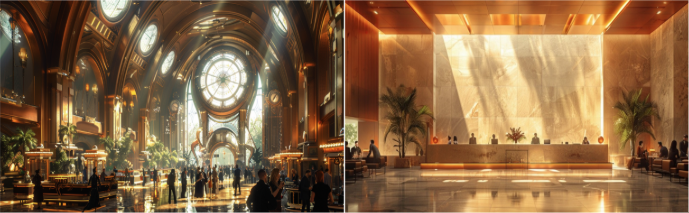
Two grand hotel lobby images generated with Midjourney based on similar text prompts but with distinctly different styles descriptions.
The Three Pillars of Creative Hotel Design
True architectural innovation still rests on three timeless foundations:
- Architectural Form – the visual and structural identity of the building.
- Floor Plans – how spaces function and flow.
- Spatial Composition – how guests experience movement and emotion throughout those spaces.
Traditional GenD tools can optimize a hotel’s function and efficiency but often produce predictable layouts. GenAI, by contrast, introduces creative unpredictability—generating novel forms, inspiring new spatial ideas, and reimagining how guests interact with architecture.
For example, future AI systems could pair floor plans with 3D volumes to learn stylistic logic (modernist, baroque, tropical, or minimalist) and produce floor plans that reflect those sensibilities. This opens new potential for brand differentiation in the hospitality industry, where design can convey emotion, story, and experience.

Toward Spatial Choreography: Designing Guest Experience Through AI
Imagine a design process where AI helps choreograph how a guest feels from the moment they arrive. Generative AI could soon analyze how light, volume, and texture interact across sequential spaces—from the entry drive to the lobby, restaurant, and guest suites—crafting an immersive journey rather than just a layout.
Experimental tools such as NVIDIA’s Scenescape and research into Isovist Fields are exploring how to use AI to generate “spatial sequences”, 3D environments that evolve dynamically, almost like scenes in a film. For hotels, this could redefine the way we approach experiential design, ensuring every guest movement feels intentional and emotionally resonant.
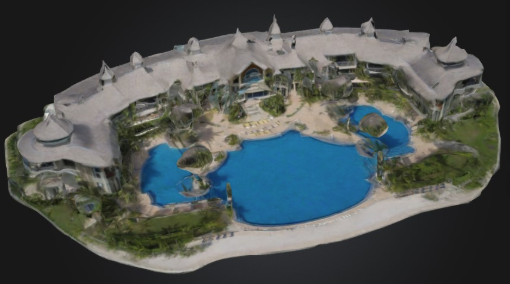
3D mesh-based model created with Meshy AI. Prompt: large sprawling beachfront resort, 3-stories, Shingle Style, symmetrical layout, with large pool in front and canopy at the entrance, ornamental rooftop.
Data: The New Building Material
Behind every successful GenAI tool is data, and lots of it. Platforms are now training on enormous datasets such as LAION-5B (billions of image-text pairs) and Objaverse-XL (millions of 3D models). For hospitality design, curated data will be key.High-quality datasets built from real hotel projects, 3D assets, and annotated plans can train AI systems to understand the nuances of brand standards, guest flow, and spatial aesthetics. Thoughtful data curation helps maintain authorship, style integrity, and originality while avoiding generic results.
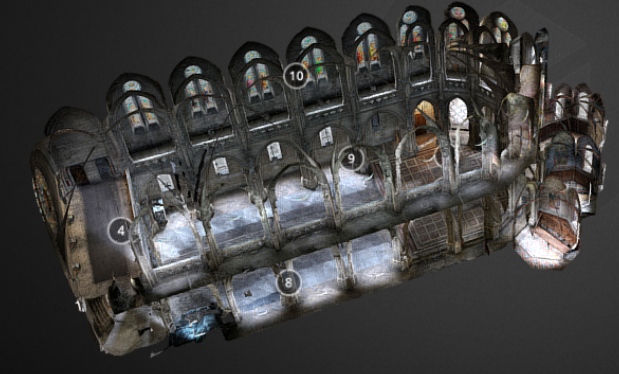
Full detail 3D model of Chapelle du Crous interior from SketchFab.
3D models based on high-detail scans of interior environments provide a rich dataset in the pipeline for GenAI spatial composition.
The Future: Merging Logic and Imagination
The next decade will likely see the convergence of Generative Design and Generative AI – where technical optimization meets creative exploration. In hotel design, that means faster workflows, deeper insight into guest experience, and entirely new forms of architectural storytelling.
While it’s tempting to imagine AI creating complete, code-compliant hotel blueprints automatically, human creativity will always remain essential. AI should be viewed as a collaborator—a powerful new tool in the architect’s and consultant’s toolkit—to push the boundaries of innovation while keeping the guest experience at the heart of every decision.
Generative AI isn’t replacing architects or hotel designers; instead it’s amplifying human imagination. For hotel developers and consultants, embracing these tools means designing smarter, more distinctive, and emotionally engaging spaces that define the future of hospitality.
At Majestic Hospitality, we help hotel owners, developers, and operators bring visionary concepts to life through innovative design and strategy. From exploring emerging technologies like Generative AI to reimagining the guest experience through architectural storytelling, we guide you toward solutions that blend creativity, efficiency, and impact.
Connect with us to discover how our team will use generative AI in hotel design, and how these tools can elevate your property’s vision, from concept to guest experience.
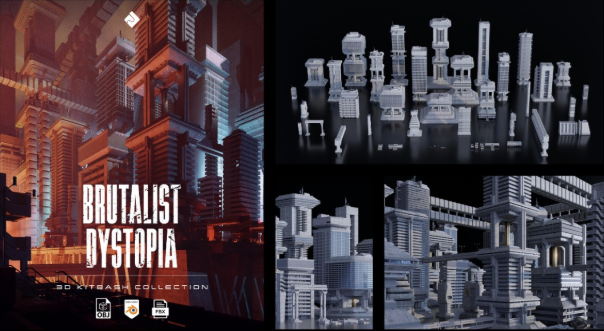
The Kitbash3D BRUTALIST DYSTOPIA kit features a collection of cyberpunk-style 3D architectural assets that could populate a dataset for 3D building design generation.